
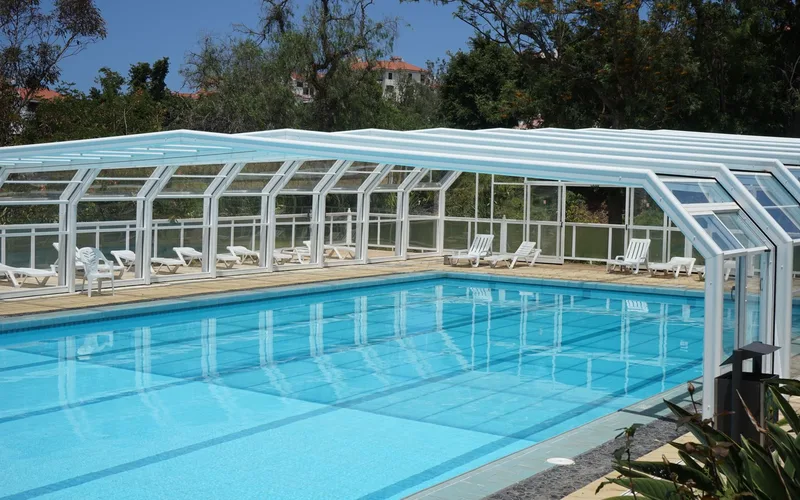
For a Chicago-area pool, reserve space from the selected cover’s dimensioned details before fixing the deck edge, entry landing or gate location.
Draw the cover in every position
Use a top view for track routes, travel, controls and deck passage, and a side section for the shell edge, coping, channel and mechanism housing. Show the cover closed, moving, fully stowed and being serviced. Compare an underside-track layout with a compatible wall-channel option rather than assuming the water outline is also the cover footprint. In one manufacturer’s track drawings, underside tracks are an option for suitable rectangular pools and the mechanism usually stows below the deck. Some channel details accommodate raised walls or fiberglass shells; an inverted channel can sit at the wall’s top edge or be recessed. Vinyl-liner channel corners vary, so check the actual corner shape against the track detail. Use the drawings as examples, not as dimensions for another system.
Walk the housing, service and storage routes
Mark the proposed housing and gate swing on the ground. If opening the housing for service would take up the entry landing or the only deck passage, try moving the housing or gate on the plan and compare again. Walk the route to any separate seasonal storage, measure the tight doorway and check the turn into it. Ask the installer for the sizes of parts that must pass through and the working room needed to reach and remove them. Don’t count an area as available just because the pool is shown open.
Confirm fit before the builder’s drawings go out
Get the exact shell and cover pairing, track location, housing section, service access and controls confirmed by the manufacturer and installer. Manufacturer guidance for underside tracks calls for advance coordination. Keep any barrier question separate: the CPSC guide distinguishes a power safety cover from a generic cover and discusses door alarms and other protections for dwelling access separately. A closed-cover view doesn’t show what protects an opening when the cover is stowed. Ask the local authority about any proposed reliance on the exact cover; don’t assume it replaces a barrier.